
PROGRAMMABLE BIOLOGY
DNA-guided CRISPR
for donor organs.
Our team’s work expands what CRISPR–Cas12 can recognize and do. DNA-based guides are the foundation of our current RNA-targeting approach.
Guide sequences direct the system toward selected molecular targets, creating a way to investigate the pathways that shape organ injury and resilience.
Experimental cryo-EM structure · 3.18 Å
Fregoso Ocampo et al. · View structure
- 01 / THE TOOL
A programmable guide
Directing CRISPR toward a selected molecular target.
- 02 / THE ACTION
Targeted RNA reduction
Investigating a change in selected gene activity.
- 03 / THE ORGAN QUESTION
Kidney resilience
Testing whether molecular activity can translate into organ benefit.
PUBLISHED PLATFORM EVIDENCE
NATURE BIOTECHNOLOGY / 2026
One target at a time.
Or four together.
Published experiments show RNA reduction with individual ψDNA guides and with four guides combined.
Individual knockdown
One guide per target
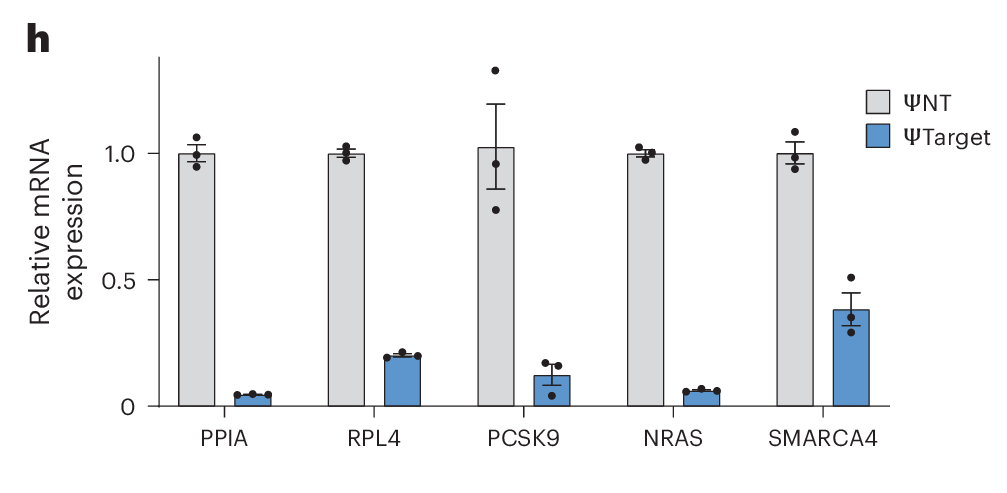
Original panel from Fig. 3h, Orosco, Huang, Rananaware et al., Nature Biotechnology (2026).
Multiplex knockdown
Four targets in one experiment
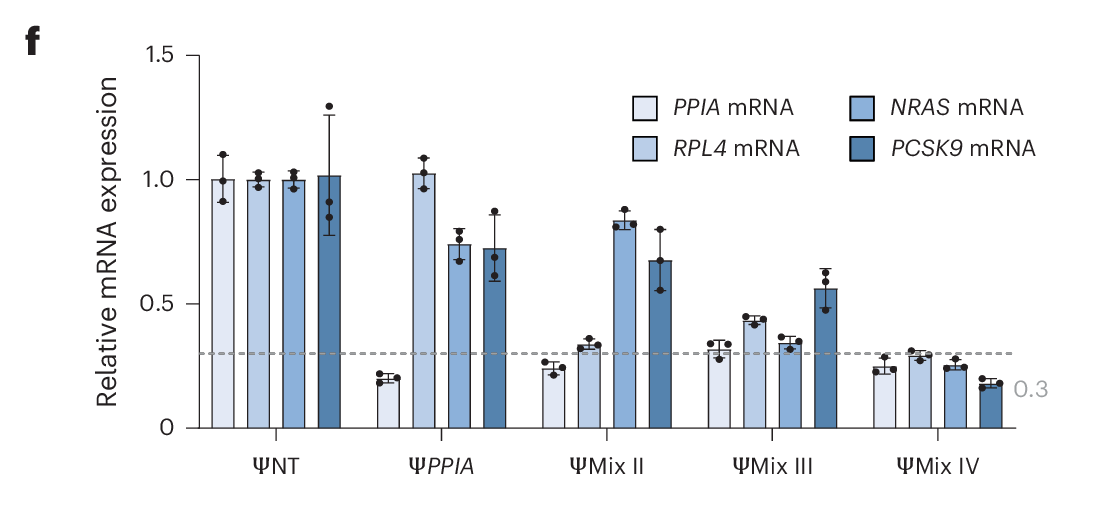
Original panel from Fig. 4f, Orosco, Huang, Rananaware et al., Nature Biotechnology (2026).
OUR FIRST PROGRAM
Start with the kidney.
Build the evidence.
Our first organ program investigates pathways involved in preservation and reperfusion injury. A focused beginning for a broader organ-engineering vision.
- NOW / CURRENT RESEARCH
Human donor
kidney tissueInvestigating RNA knockdown and molecular activity in donor kidney tissue.
- NEXT / PLANNED EVALUATION
Whole-organ
perfusionStudy treatment distribution, target engagement, injury markers, and organ function in a perfused kidney.
- BEYOND / LONG-TERM VISION
Programmable
organ biologyExpand RNA programming and explore a separate future path toward durable DNA editing.
THE NEXT QUESTIONS